Online banks vs traditional banks has become one of the most relevant financial comparisons for American consumers, especially as digital banking grows rapidly across the country. Because financial habits continue evolving, people increasingly want lower fees, easier access, and better returns on their savings. As a result, the choice between digital and physical banking impacts everyday finances more than ever.
Additionally, online banks and traditional banks operate under different cost structures. Therefore, they deliver different advantages depending on how you manage your money. While online banks usually cut fees and raise APY, traditional banks offer face-to-face assistance, broader product lines, and nationwide branch networks. Consequently, understanding each model helps consumers avoid unnecessary expenses.
Even so, many people question whether the lowest-cost option is always the best. The answer depends on individual needs, comfort with technology, account habits, and how frequently you rely on physical services. Thus, analyzing these banking models side by side provides clarity and helps you make confident choices.
To understand how to save more money and select the banking option that matches your financial goals, continue reading. This guide offers a complete, data-based comparison using official U.S. banking sources and current market standards.
Online Banks vs Traditional Banks: Main Differences
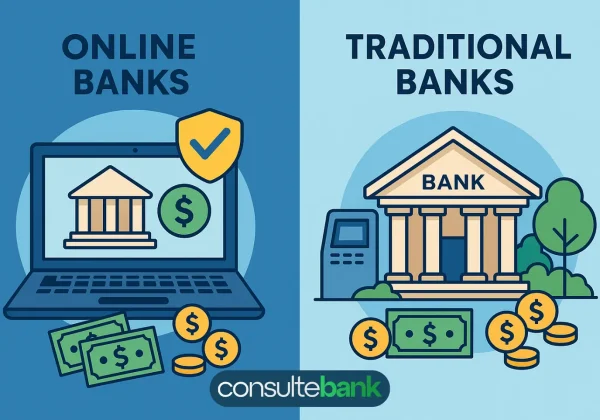
The rise of online banks in the United States is driven by convenience and affordability. Since these institutions operate without physical branches, they reduce overhead costs significantly. As a result, they can offer fee-free accounts and competitive interest rates. Traditional banks, on the other hand, carry higher operating expenses due to their branch networks, staffing, and physical infrastructure.
Because of these structural differences, each model has advantages. Understanding these distinctions allows you to identify where the cost savings truly occur.
Operational structure and cost impact
Online banks streamline operations through technology. This reduces fixed expenses and allows them to eliminate monthly maintenance fees and minimize service charges. Conversely, traditional banks must fund branch operations, which often leads to higher account fees, especially for basic checking accounts.
Daily access and user experience
Most online banks offer modern, user-friendly mobile apps with tools for budgeting, automated savings, and real-time account alerts. However, consumers who prefer speaking to someone in person may feel more comfortable with traditional banks. While digital banks focus on speed and automation, physical banks provide face-to-face guidance.
Benefits of Online Banks
Online banks appeal to people who want to save money consistently throughout the year. Because they operate digitally, they offer features designed to minimize costs while improving usability.
Lower fees
Most online banks offer checking and savings accounts with zero monthly maintenance fees. Furthermore, everyday services such as mobile deposits, ACH transfers, and bill pay are typically free. Although some specialized transactions may involve fees, the overall cost structure is usually much more affordable.
Higher APY
Online savings accounts typically offer interest rates far above the national average. Because these banks reduce operational expenses, they can pass savings directly to consumers. Therefore, individuals seeking to grow their savings often benefit more from online banks.
Fully digital experience
Because all operations occur online, customers can manage finances anytime without visiting a branch. Additionally, digital banks often provide advanced app features such as instant balance updates, spending insights, and automated budgeting tools.
Benefits of Traditional Banks
Traditional banks remain essential for millions of Americans. Despite the shift toward digital banking, these institutions offer features that online banks cannot fully replicate.
In-person support
Many consumers value face-to-face guidance for complex financial matters, including loans, credit consultation, and dispute resolution. Therefore, traditional banks offer added reassurance for people who prefer human interaction.
Access to specialized financial services
Large banks typically offer broader financial products, such as small-business loans, home equity lines, and in-depth wealth management. Furthermore, they provide extensive ATM networks, including machines that support cash deposits—an area where many online banks still rely on partner networks.
Established reputation and long-term trust
Traditional banks have decades, sometimes more than a century, of operational history. Because of this, many consumers feel more comfortable relying on institutions with proven stability and nationwide recognition.
Online Banks vs Traditional Banks: Fees Comparison
Fee structures vary significantly, and understanding these differences is essential for determining which option saves you more money.
Monthly maintenance fees
- Online banks: usually US$0.
- Traditional banks: typically between US$5 and US$25, unless certain conditions are met (such as direct deposit minimums).
ATM fees
- Online banks: often reimburse ATM surcharges nationwide.
- Traditional banks: charge fees when customers withdraw from out-of-network ATMs.
Overdraft fees
- Online banks: many have eliminated overdraft fees entirely.
- Traditional banks: common rates range from US$25 to US$35 per overdraft incident.
Wire transfer fees
- Online banks: usually lower, and sometimes free.
- Traditional banks: domestic outgoing wires commonly cost US$25–US$45.
As a result, customers with basic banking needs typically spend less with online banks. However, people who frequently visit branches or require specialized assistance may find physical banks more practical.
Savings and APY Comparison
Interest earnings can significantly influence long-term savings. Because APYs differ dramatically between account types, comparing both models is essential.
Average APY at online banks
Commonly ranges from 3% to 5% annually, depending on market conditions.
Average APY at traditional banks
Typically remains below 1% for standard savings accounts, even for customers with long banking relationships.
Consequently, online banks tend to be more rewarding for individuals focused on maximizing savings returns.
Security: Are Online Banks Safe?
Security remains a major concern for many people unfamiliar with digital-only institutions. Nevertheless, regulated online banks are just as safe as traditional banks.
Federal deposit insurance
Both online banks and traditional banks provide FDIC insurance of up to US$250,000 per depositor, per institution, per ownership category. Therefore, deposit protection is identical across both models.
Cybersecurity protections
Online banks invest heavily in encryption, multi-factor authentication, and continuous fraud monitoring. Although traditional banks also use advanced security technology, online banks often update systems faster due to their digital-first structure.
Because both operate under federal oversight, customers receive equal regulatory protection as long as the bank is FDIC-insured.
Which One Saves You More Money
While the ideal choice depends on your financial habits, online banks generally offer lower fees and significantly higher APYs. Therefore, for most consumers who want to cut banking costs and maximize savings returns, online banks provide a clear financial advantage.
Still, traditional banks remain valuable for people who rely on in-person service, need access to complex financial products, or prefer a long-established institution.
Final Thoughts
Online and traditional banks each serve important roles within the U.S. financial system. However, if your priority is minimizing fees and increasing savings growth, online banks usually deliver superior value.
Even so, the best choice depends on your preferences, lifestyle, and financial goals. Because of that, evaluating both options carefully is essential.
When you compare account features, APYs, service coverage, and support structure, you can make a more informed decision and improve your overall financial stability.
Fontes oficiais e recomendáveis
- Federal Deposit Insurance Corporation (FDIC)
- Consumer Financial Protection Bureau (CFPB)
- Federal Reserve – Data & Research
- Office of the Comptroller of the Currency (OCC)
📌 Leia também:
Best Credit Cards Best Digital Banks in the USA No annual fee cards USA👉 Continue lendo o Consulte Bank